
Construction projects no longer succeed on momentum alone. Rising material costs, layered regulations, compressed schedules, and increasingly specialized scopes have made owner oversight more demanding than ever. In this environment, an owner’s representative provides the structure and oversight owners need to manage risk effectively.
An owner’s representative is a professional engaged to act exclusively on the owner’s behalf throughout a construction project. Their role is to protect the owner’s interests, translate complexity into clear decisions, and ensure that planning, design, and construction remain aligned with the project’s original intent. Unlike contractors or design teams, an owner’s representative has no competing priorities. Their accountability runs in one direction only: to the owner.
At its core, owner’s representative services provide owners with experienced oversight when internal capacity, technical expertise, or time is limited. From early planning through close-out, the owner’s representative becomes an extension of the owner’s team, monitoring performance, managing risk, and maintaining control as projects evolve.
In an industry where material costs have risen sharply and project teams spend significant time resolving avoidable conflicts, having a dedicated advocate focused solely on outcomes can determine whether a project stays on course or veers into costly correction.
Why Owner’s Representation Has Become Essential

Before breaking down responsibilities, it’s useful to understand why this role has become a key part of successful project delivery.
Modern construction projects involve dozens of stakeholders, overlapping contracts, and regulatory pressure that leaves little margin for error. Without clear governance, owners can find themselves reacting instead of leading. Owner’s representation restores balance by providing structure, accountability, and informed decision-making from day one.
Owners who engage an experienced representative gain:
- Independent oversight that is not influenced by contractor or consultant incentives
- Early identification of risks before they impact budget or schedule
- Clear communication across technical and non-technical stakeholders
- Confidence that decisions align with long-term operational and financial goals
This proactive involvement is especially valuable for public agencies, municipalities, developers, and institutions managing capital programs with long timelines and public accountability.
Core Responsibilities of an Owner’s Representative
An owner’s representative is involved across the full project lifecycle, not just during construction. Their responsibilities are comprehensive, practical, and rooted in execution.
1. Acting as the Owner’s Advocate

At every stage, the owner’s representative serves as the owner’s voice. They evaluate recommendations, challenge assumptions when needed, and ensure decisions reflect the owner’s priorities rather than default industry habits.
This advocacy is especially important when scope changes, unforeseen conditions, or budget pressures arise. The owner’s representative provides objective guidance, so decisions are made deliberately, not reactively.
2. Budget Oversight and Cost Control
Financial discipline is central to successful delivery. Owner’s representatives track costs from early estimates through final close-out, reviewing contracts, change orders, and pay applications to ensure transparency and accountability.
This oversight helps prevent small cost deviations from compounding into major overruns and identifies opportunities to preserve value without sacrificing performance.
3. Schedule Management and Coordination
Schedules only work when someone enforces them. Owner’s representatives establish realistic timelines, monitor progress against milestones, and address conflicts before delays ripple across the project.
Rather than managing tasks, they manage accountability, ensuring designers, contractors, and agencies meet their commitments.
4. Centralized Communication
Construction breakdowns often stem from miscommunication, not technical failure. Owner’s representatives serve as the central point of coordination among owners, architects, engineers, contractors, and regulatory bodies.
By filtering information and clarifying decisions, they keep teams aligned and reduce costly misunderstandings.
5. Risk Identification and Mitigation
From procurement strategy to site conditions, risk is present long before problems surface. Owner’s representatives identify exposure early, implement mitigation strategies, and resolve conflicts before they escalate into disputes or delays.
6. Quality Assurance and Compliance
Through site observations, document reviews, and coordination with inspectors, owner’s representatives verify that work complies with specifications, codes, and regulatory requirements.
Quality is not left to chance, it is monitored, documented, and enforced.
The Measurable Benefits of Owner’s Representative Services

The value of an owner’s representative is not theoretical. It shows up in cost control, schedule reliability, and reduced friction throughout delivery.
As construction costs continue to rise and project teams lose valuable time addressing avoidable conflicts, owner’s representatives provide a stabilizing force that keeps projects focused.
It’s worth noting that these benefits compound when owner’s representation begins early. Their impact can be summarized across five key benefit areas:
- Stronger decision-making: Access to experienced judgment grounded in real-world project delivery
- Cost discipline: Continuous financial oversight that protects capital investment
- Clear communication: One point of accountability for information flow and alignment
- Consistent quality: Independent verification that standards are met at every phase
- On-time delivery: Active schedule oversight that prevents drift and delay
These advantages apply across a wide range of construction projects, from large public infrastructure programs to complex institutional and municipal facilities. Whether delivering transportation corridors, education campuses, municipal buildings, vertical institutional developments, cross-border bridge expansions, or broadband infrastructure programs, success depends on strong coordination and clear decision-making.
Projects of this scale require alignment across jurisdictions, agencies, consultants, and contractors, along with careful regulatory navigation and consistent stakeholder engagement. In these environments, the owner’s representative ensures the project stays aligned with the owner’s long-term operational, financial, and community goals while managing regulatory complexity throughout the process.
How the Owner’s Representative Fits Into the Construction Project Team
Construction projects involve several key participants, each responsible for a different part of the process. While titles such as project manager, contractor, and owner’s representative are sometimes used interchangeably, the key distinction lies in who each role represents and how their incentives are structured.
Design professionals are responsible for developing the project’s plans and specifications. Contractors are responsible for building the project according to those plans.
Owner’s Representative vs Designer/Architect vs Contractor vs Project Manager
An owner’s representative serves a different role. Their responsibility is owner advocacy. They ensure that the project remains aligned with the owner’s goals, budget, schedule, and operational needs from planning through construction.
In many construction delivery models, design and construction services are compensated in relation to the overall construction value. As project scope increases, these associated fees may increase as well.
Owner’s representative services are typically structured differently. Compensation is usually based on the level of effort required to support the project, including staffing needs and project duration, rather than the cost of construction itself.
This structure allows the owner’s representative to remain focused on what matters most to the owner:
- Maintaining scope discipline
- Protecting the project budget
- Supporting objective, data-driven decision making
- Improving project efficiency and coordination
Rather than replacing designers or contractors, the owner’s representative provides independent leadership and oversight, helping ensure the entire team stays aligned with the owner’s priorities.
When roles are clearly defined and communication remains consistent, the project team can work together more effectively to deliver successful outcomes.
When to Engage an Owner’s Representative
The most effective time to engage an owner’s representative is early, during planning and pre-design. Early involvement allows them to help define scope, establish realistic budgets, evaluate delivery methods, and set expectations before commitments are locked in.
Waiting until construction begins limits the value they can provide. Early engagement reduces downstream changes, improves procurement decisions, and creates a stronger foundation for execution.
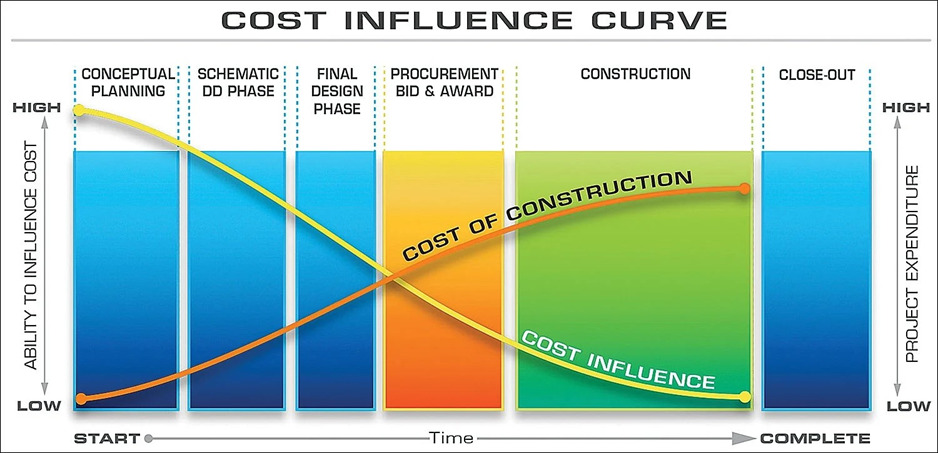
This dynamic is illustrated by the Cost Influence Curve. Early in a project’s lifecycle, owners have the greatest ability to influence the overall cost and direction of the project. As design progresses and construction begins, that ability decreases while the cost of making changes increases.
Engaging an owner’s representative early allows the owner to benefit from strategic oversight and risk mitigation when it has the greatest impact. This includes helping to:
- Align project scope, schedule, and budget
- Identify potential risks before they affect delivery
- Support clear communication between stakeholders
- Guide key planning and procurement decisions
When brought in later, the owner’s representative often focuses on resolving issues that have already developed. Early involvement allows the role to be proactive, thus helping shape the project strategy rather than reacting to challenges after they occur.
Owner’s Representation with Brownstone Consultants
At Brownstone Consultants, owner’s representation is grounded in practical execution, not theory. The firm acts as a true extension of the owner’s team, providing clear oversight, technical fluency, and disciplined project governance across every phase.
With deep experience across infrastructure, municipal, education, and development projects in South Texas, Brownstone understands the regulatory environment, stakeholder dynamics, and regional constraints that shape successful delivery. Their approach emphasizes transparency, accountability, and measurable results.
From early planning through close-out, Brownstone Consultants safeguards owner interests, controls risk and keeps projects moving forward with purpose.
To learn more about how Brownstone Consultants supports owners through effective representation and project oversight, visit their website and contact them today.